AI Signals
Pattern-detected option setups across the tape
What AI Signals are
AI Signals are short, structured pattern callouts distilled from live options flow: when the platform recognizes that the prints on a single name are forming a shape worth attention—aggressive accumulation, repeated sweeps at the same strike, multi-leg structure, a sudden ratio change—it surfaces that pattern as a single signal row rather than as dozens of raw prints.
Where AI Anomaly Detection ranks individual prints by statistical rarity, AI Signals look at clusters and shapes across many prints and ask, “is this starting to look like a recognizable setup?”
Availability: Theta and Vega plans
Where to find them:
- Sidebar card on Unusual Options Activity — the AI Signals panel on the right side of the page, alongside AI Anomaly Trades and High Risk Trades.
- Terminal → AI tab group → Signals — each signal as a row next to live flow and your chart.
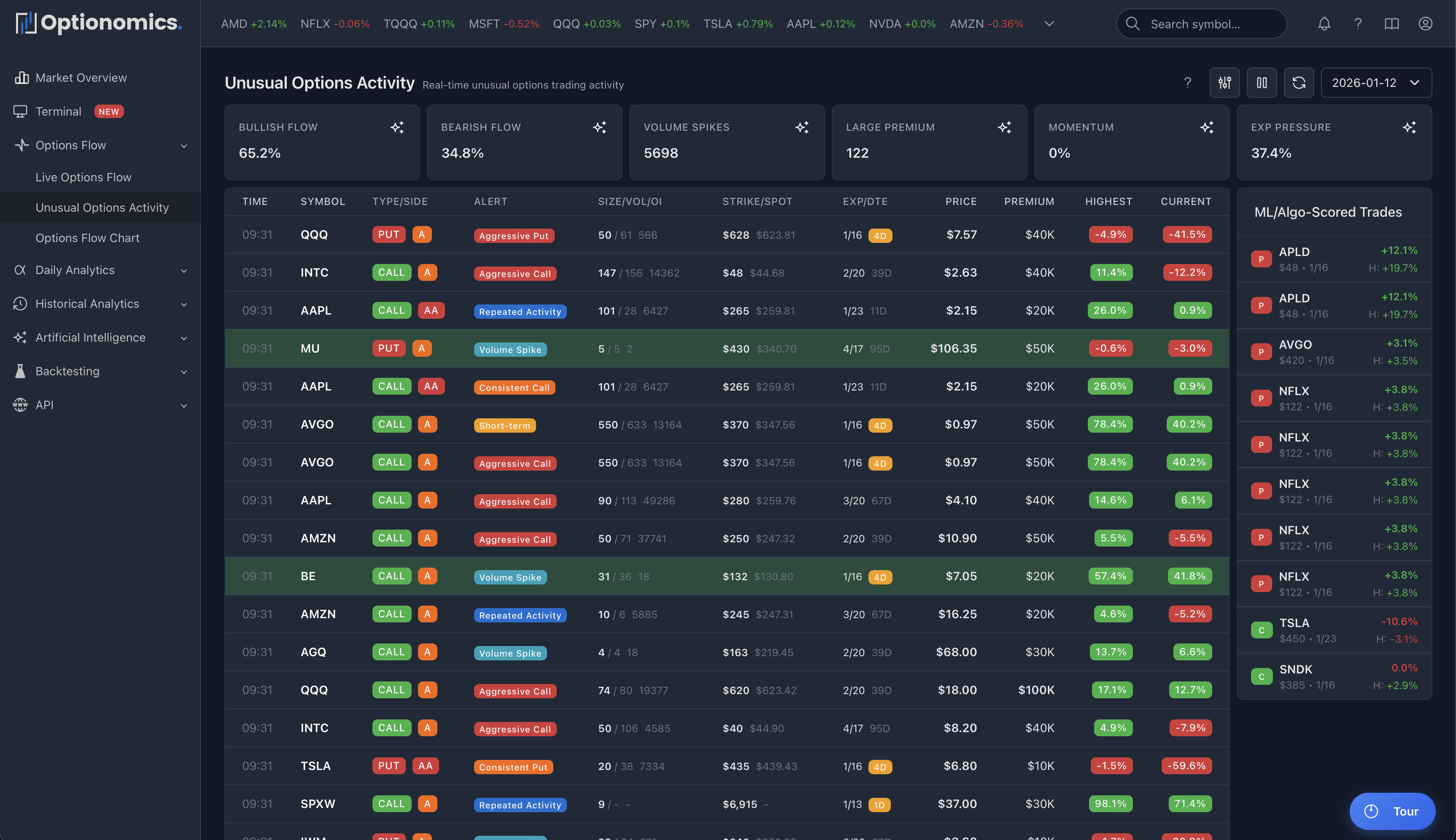
What each signal shows
| Field | Meaning |
|---|---|
| Direction badge | B (bullish), R (bearish), or N (neutral) — color-coded |
| Symbol | Underlying ticker (links to the stock view) |
| Signal type | Short label for the recognized pattern (e.g., aggressive accumulation, repeated sweep, multi-leg structure) |
| Total premium | Aggregate dollars across the prints that built the signal |
| Time | When the signal was generated |
A signal is not a quote, an order, or a trade ticket—it is a callout that some shape on the tape has crossed an internal threshold worth surfacing.
How signals fit with everything else
Think of the AI surface as three layers, from rawest to most distilled:
| Layer | What it is | Where to find it |
|---|---|---|
| Live tape | Every print, as fast as we can show it | Options Flow |
| Curated alerts | Rule-based unusual-activity types (whale, sweep, volume spike, etc.) and ML-scored anomalies | Unusual Activity · Anomalies |
| AI Signals | Pattern callouts across many prints on the same name | This page + Terminal Signals tab |
Many traders read the signal first to know which name to open, then drop into raw flow or anomalies to see why the signal fired.
Using signals well
- Treat a signal as “look here next”, not “buy here now.”
- Open the symbol and check option walls, gamma exposure, and IV/skew before you commit—signals describe flow shape, not the broader structure of the chain.
- Watch the direction badge: a bullish-flagged signal that prints into a strong call wall above means something different from one printing into clear sky.
- Compare against Smart Money Conviction for the same name—if both agree, the story has multiple legs.
Signals as input to other AI features
AI Signals are also fed into the trade-idea pipeline as a high-conviction input: when a signal lines up with other evidence on a name, it can contribute to a generated Trade Idea. You will not always see a one-to-one mapping (signals can fire without producing an idea, and ideas can come from other inputs), but the two surfaces share DNA.
Important context
- Pattern recognition is probabilistic. A recognized shape does not guarantee the move continues.
- Multi-leg structures (spreads, condors) often look directionally one-sided on the tape but are structured to be range-bound—use chain context before assigning direction.
- Premium totals reflect what the platform was able to attribute to the pattern, not necessarily every related print.
Remember: Signals exist to compress raw tape into something scannable. The decisions are still yours—size, manage, and exit on your own rules.
Related:
